Better you find your WCAG issues than a regulator
- 2025.06.28
- EAA in force EU-wideThe day the EAA became enforceable EU-wide
- EUR-Lex, Art. 31 (opens another site in a new tab)
- €100,000
- Max. fine per violation (DE)Max. fine per violation in Germany (BFSG)
- BFSG § 37 (opens another site in a new tab)
0 accessibility errors on our own site (last checked 30 Sept 2026)How we test
New standard · September 2026
The new EN 301 549 is out. We already test to it.
On 2 September 2026 ETSI published EN 301 549 V4.1.1, the European accessibility standard behind the EAA. It moves from WCAG 2.1 to WCAG 2.2 level AA and adds six success criteria. EqualVia covers all six today: target size in the automated scan, the other five in the guided manual checks. Your reports give the new clause numbers alongside the current ones.
The legal status, honestly
V4.1.1 isn't cited in the Official Journal of the EU yet. Until it is, V3.2.1 (WCAG 2.1 AA) is the edition that gives the presumption of conformity. WCAG 2.2 AA includes every WCAG 2.1 AA requirement (the one it drops, 4.1.1 Parsing, is now treated as always met for HTML), so testing to the new edition covers the current one too.
AccessibleEU announcement (opens another site in a new tab)What do A and AA mean?TipWCAG has three levels: A (the basics), AA and AAA. EN 301 549, and so the EAA, asks for everything at levels A and AA; AAA is optional.
- WCAG 2.4.11 · Level AAGuided check
Focus not obscured (minimum)
- WCAG 2.5.7 · Level AAGuided check
Dragging movements
- WCAG 2.5.8 · Level AAAutomated scan
Target size (minimum)
- WCAG 3.2.6 · Level AGuided check
Consistent help
- WCAG 3.3.7 · Level AGuided check
Redundant entry
- WCAG 3.3.8 · Level AAGuided check
Accessible authentication (minimum)
The whole workflow
A scan is only the start. EqualVia takes you the rest of the way.
Automated scan
axe-core plus six checks of our own run across your site's pages and the PDF documents they link to, then again on a schedule.
See the engineGuided manual checks
New16 step-by-step checks for what no machine can judge: does it work by keyboard, can you check out with a screen reader, does the alt text say anything, are form errors clear, does it hold up at 200% zoom. About 40–60 minutes, no expertise needed.
Fix and verify
NewEvery issue comes with a plain-language explanation and a suggested code fix. Fixed one? Click “I fixed it”: we re-scan the affected pages within minutes and confirm it's gone. Scheduled rescans email you if something comes back.
See a sample reportEvidence log
NewEvery scan, verified fix, manual result and exclusion, dated, in one PDF. Plus a draft accessibility statement filled in from your results.
Why it matters
How it works
All you need to know, in five slides
Evidence log
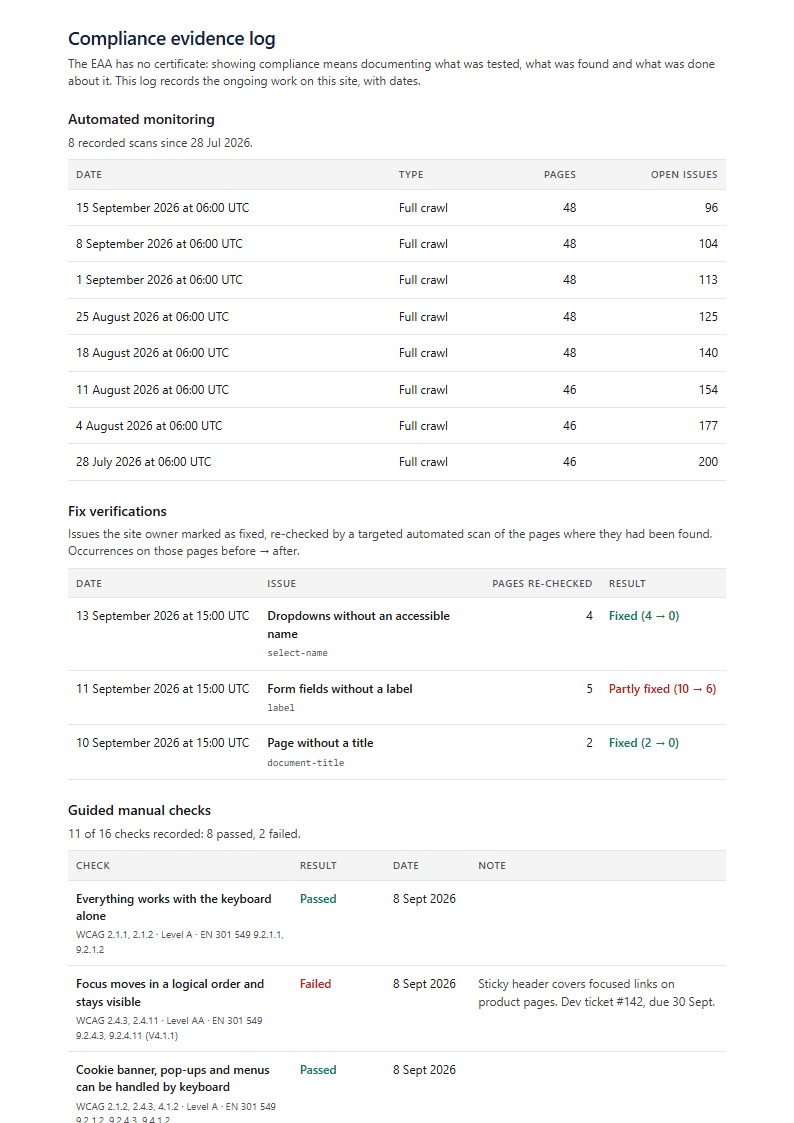
The EAA has no certificate. Your proof is the paper trail.
When an authority or a customer asks, what counts is what you tested, what you found, what you fixed, and when. Under the Act, national authorities check services, follow up complaints and verify that problems were actually corrected. EAA, Article 23 (opens another site in a new tab)
- A dated log of every automated scan and its open issues
- Your manual check results, with dates and notes
- Issue types you excluded, listed openly, not tucked away
- A draft accessibility statement filled in from the results
Our own scan engine
A perfect Lighthouse score isn't WCAG compliance
| Check | axe-core / Lighthouse alone | EqualVia |
|---|---|---|
| Text contrast over gradients and imagesNoaxe-core / Lighthouse alone: Skipped — left for manual review | NoSkipped — left for manual review | YesMeasured on the real pixels |
| Wrong declared page languageNoaxe-core / Lighthouse alone: Any valid lang code passes | NoAny valid lang code passes | YesDetects the real language (15 EU languages) |
| Visible keyboard focusNoaxe-core / Lighthouse alone: Not tested | NoNot tested | YesEach style of link, button and field focused and compared |
| Keyboard trapsNoaxe-core / Lighthouse alone: Left for manual review | NoLeft for manual review | YesTabs through the page and its embedded widgets, like a keyboard user |
| Linked PDF documentsNoaxe-core / Lighthouse alone: Not tested | NoNot tested | YesTags, text layer, image alt text, language and title of each PDF |
| 320px reflow (400% zoom)Noaxe-core / Lighthouse alone: Not tested | NoNot tested | YesPoints to the element that overflows |
| Text spacingPartlyaxe-core / Lighthouse alone: Only inline !important styles | PartlyOnly inline !important styles | YesReal spacing applied, clipped text reported |
| Accessibility overlay widget on the pageNoaxe-core / Lighthouse alone: Not reported | NoNot reported | YesNamed in the report, with what it doesn't fix |
| Whole site, re-checked on scheduleNoaxe-core / Lighthouse alone: One page per manual run | NoOne page per manual run | YesMulti-page crawl + scheduled rescans |
| Fix for each issuePartlyaxe-core / Lighthouse alone: Rule description and docs link | PartlyRule description and docs link | YesPlain-English explanation + code fix |
The report
You don't just get a list of problems. You get the fixes.
Issues arrive ranked by severity. Each one says in plain English what's wrong and who it affects, with a concrete code fix you can paste in. Not a cryptic rule ID.
Multi-page crawls
WCAG and EN 301 549
Data export
- critical
Images without alternative text
image-alt
How to fix thisWhat we found
Screen reader users have no way to know what this image shows or does — if it's also a link, they may not even know it's clickable.
img.hero-bannerSuggested fix
<img src="/hero-banner.jpg" alt="Team working in the dev office">
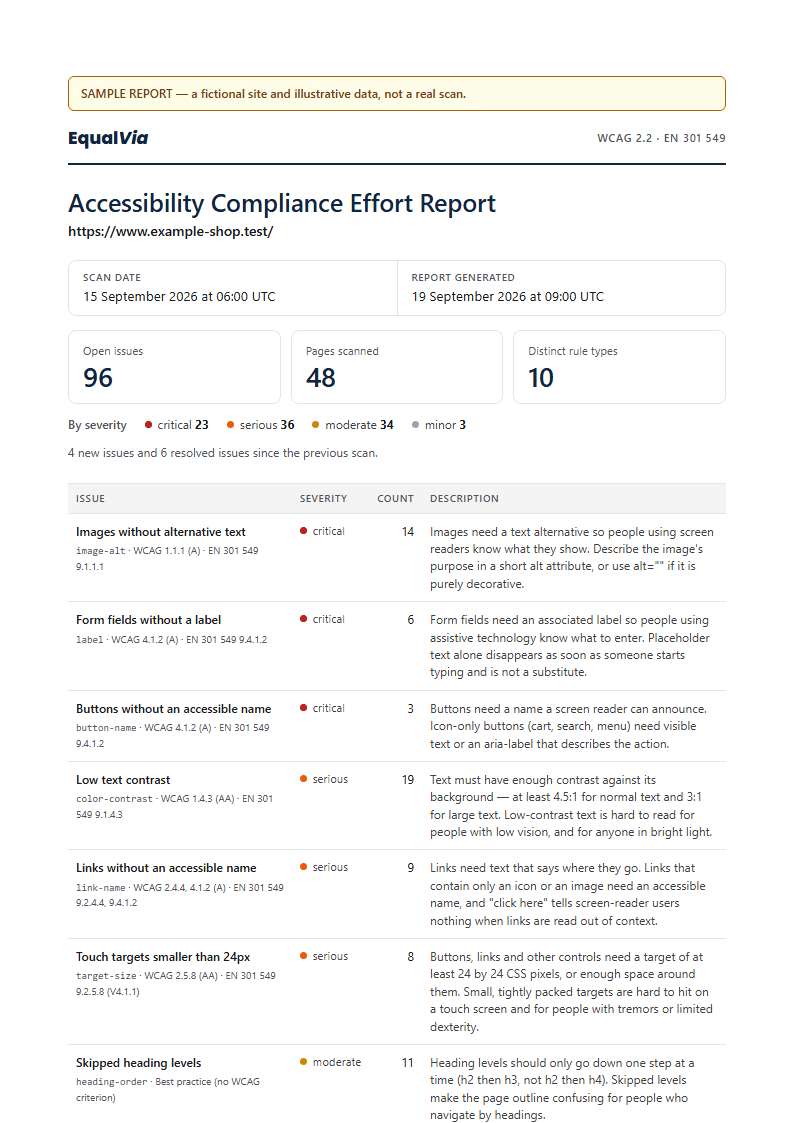
PDF report
For auditors and clients
A downloadable compliance report you can forward as is, on the Starter, Growth and Agency plans. Made-up site, fictional data.
Continuous monitoring
Fixed once ≠ fixed forever
- Scheduled rescans weekly, every 3 days or daily, depending on your plan
- An email when something changes: what's new and what's resolved
- Every rescan compared with the last: see what was fixed and what came back
example.com · open issues
Sample- 47
Scan 1
Issues found
- 0
Scan 2
Fixes confirmed
- 1
Scan 3
New issue → email
- 0
Scan 4
Clean again
Email alert
1 new, 0 resolved on example.com
Overlays vs. real fixes
A widget doesn't fix your code
- April 2025: the US Federal Trade Commission ordered overlay vendor accessiBe to pay $1 million for claiming its widget could make any website WCAG-compliant. FTC (opens another site in a new tab)
- The European Disability Forum and the IAAP: overlays “do not make the website accessible or compliant with European accessibility legislation.” EDF–IAAP statement (opens another site in a new tab)
Overlay widget
- Patches symptoms in the browser at runtime
- Never touches your actual markup
- Not a route to compliance, say the FTC and the EDF
EqualVia
- Finds the real violations in your code
- Tells you exactly what to change, with a code fix
- Monitors on a schedule and emails you when something changes
Offers
Start free. Stay covered when you're ready.
Three ways in, depending on how much help you need: try it for free, keep your site monitored, or get a one-off audit with a PDF report.
Who EqualVia is for
Companies of roughly 10–250 people selling in the EU: too big for the EAA's micro-enterprise exemption, not yet big enough for a compliance team of their own.
SaaS teams
Ship an accessible product without slowing the team down. Issues arrive with code fixes developers can act on right away.
E-commerce
From product page to checkout: catch the issues before a shopper gets stuck on them or a regulator notices.
Agencies
Every client site in one place, with white-labeled PDF reports you can hand straight over.
Running WordPress?
Our free plugin checks your homepage against WCAG 2.2 right in wp-admin and shows the latest result in a dashboard widget. No account or API key needed.
Frequently asked questions
What is WCAG?
Which version of EN 301 549 do you test against?
What exactly does EqualVia test?
Does EqualVia replace a manual audit?
How do I prove my site complies with the EAA?
Am I legally compliant after a scan?
Isn't there a grace period until 2030?
How long does a scan take?
What happens to the data collected during a scan?
What sites can be scanned?
See where your site stands today
Enter your address and within minutes you'll see where visitors could get stuck. A free account unlocks the full issue list; a plan adds scheduled monitoring and PDF reports.
- First scan free, no signup
- Guided manual checks free on every account
- No lock-in — cancel anytime
- About 20% off with annual billing
Plans from€19/month